
Brake and clutch pedal pads serve as the primary physical interface between the driver and the vehicle's braking system. While often treated as simple accessories, they endure immense mechanical stress. When manufacturers cut costs by utilizing recycled rubber compounds or excessive fillers (like calcium carbonate), the mechanical integrity of the pad drops rapidly. When sourcing parts for vehicle interiors, engineers often overlook the fundamental importance of reliable automotive black rubber pedal pads, which directly impact stopping distances during emergency maneuvers.
Field data from automotive safety testing reveals three primary failure modes associated with substandard pedal rubbers:
Friction Coefficient Degradation: Shallow anti-slip grooves wear down quickly under daily friction. Once the tread depth falls below 0.5mm, the pad loses its ability to channel water away from wet shoes, leading to a hydroplaning effect and dangerous slipping during braking.
Thermal Reversion and Cracking: Poorly formulated rubber loses its cross-linking structure under repeated temperature cycles (from winter freezing to summer cabin heat). This causes the material to harden, crack, and eventually break apart, leaving exposed metal.
Chemical Swelling: In commercial applications, pedals are frequently exposed to engine oil, grease from boots, or DOT brake fluid. Low-grade rubber absorbs these hydrocarbons, causing the pad to swell, soften, and peel off the steel pedal plate.
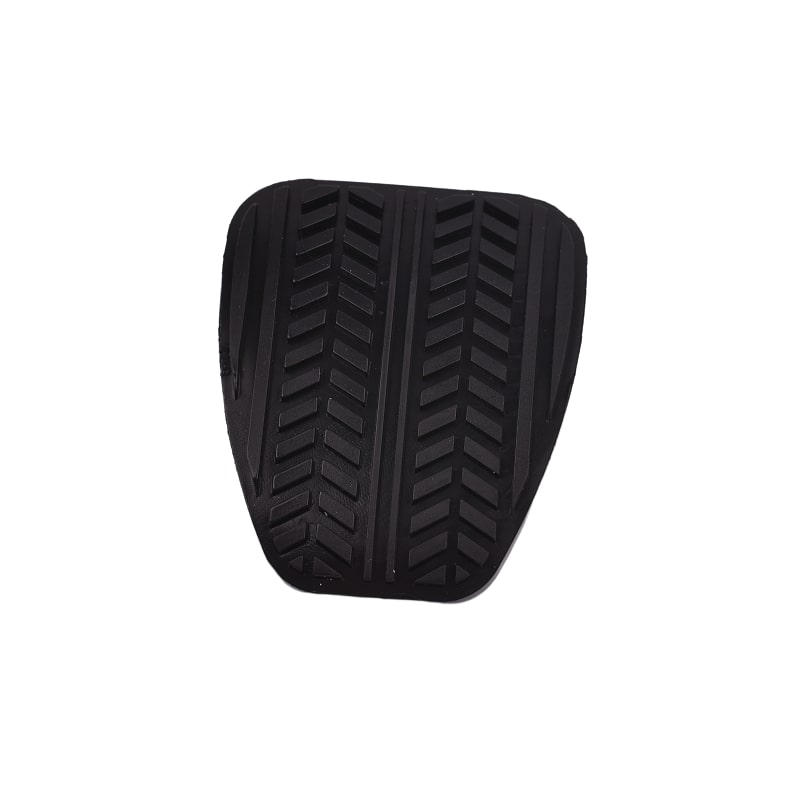
No single rubber formula fits every vehicle platform. Automotive engineering requires precise material matching based on environmental exposure, mechanical load, and target lifespan. Operating temperatures, chemical exposure, and UV radiation all dictate the base polymer selection.
We utilize three distinct automotive-grade formulas, engineered to meet specific OEM and aftermarket requirements:
1. SBR (Styrene-Butadiene Rubber) - The Aftermarket Standard
SBR provides excellent abrasion resistance and tensile strength. With a functional temperature range of -30℃ to 100℃, it easily handles the daily wear and tear of standard passenger cars. It offers a balanced cost-to-performance ratio, making it the preferred choice for high-volume aftermarket replacement parts.
2. NBR (Nitrile Butadiene Rubber) - Heavy-Duty Applications
NBR is highly polarized, giving it exceptional resistance to petroleum-based oils, fuels, and DOT brake fluids. For commercial fleets, construction equipment, and heavy trucks exposed to harsh garage environments, upgrading to custom heavy duty rubber pedal pads is a strict maintenance requirement. NBR maintains its structural integrity even after prolonged exposure to workshop fluids.
3. EPDM (Ethylene Propylene Diene Monomer) - New Energy & OEM Export
EPDM features a saturated polymer backbone, granting it superior resistance to ozone, UV radiation, and extreme weathering. Operating seamlessly between -40℃ and 120℃, EPDM does not off-gas harmful VOCs, ensuring compliance with strict interior air quality standards. It is the dominant material specified for electric vehicles (EVs) and hybrid platforms.
| Material | Tensile Strength | Temp Range | Oil Resistance | Ozone & UV Aging | Primary Application |
|---|---|---|---|---|---|
| SBR | > 14 MPa | -30℃ to 100℃ | Poor | Moderate | Passenger Car Aftermarket |
| NBR | > 15 MPa | -30℃ to 120℃ | Excellent | Fair | Commercial Trucks & Machinery |
| EPDM | > 12 MPa | -40℃ to 120℃ | Poor | Excellent | EVs, Hybrids & OEM Export |
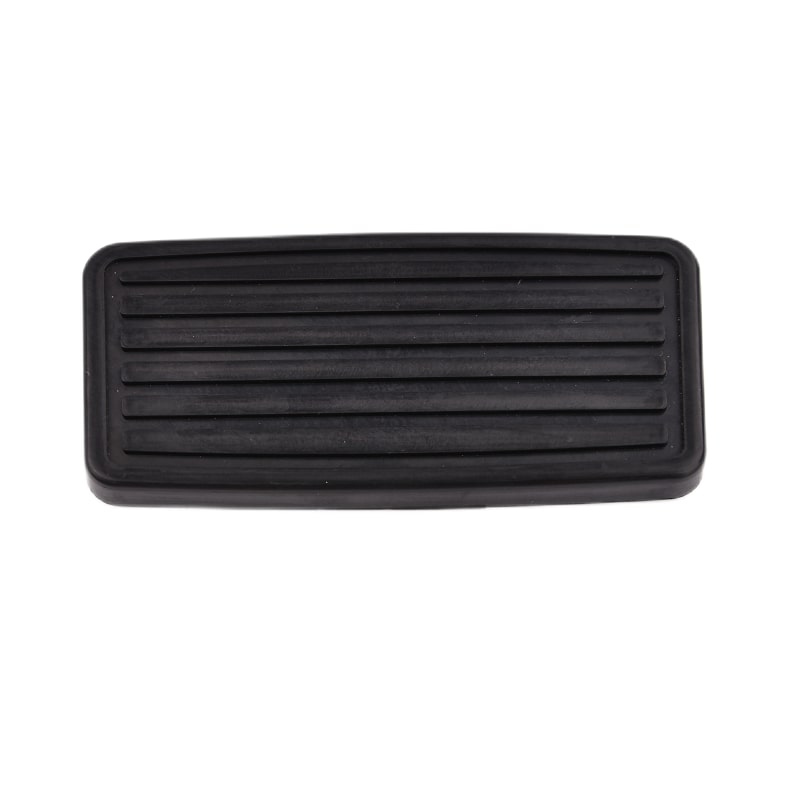
Beyond the material formulation, the physical geometry of the pad determines its grip and longevity. A flat piece of rubber offers little mechanical advantage. Through 3D modeling and dynamic friction testing, the surface tread and internal mounting structures are optimized for safety.
Gradient Trapezoidal Grooves
Rather than simple square cuts, professional pads utilize gradient trapezoidal grooves with a depth of 0.8mm to 1.2mm. This specific geometry forces water, mud, and snow outward when downward pressure is applied. Combined with engineered draft angles, the treads resist tearing at the base.
Integrated Clasping Architecture
Inferior designs rely on glues or simple tension lips that fail under extreme cabin heat. Premium pads feature an integrated internal buckle structure molded directly into the rubber lip. By calculating the exact shrinkage rate of the elastomer, the mounting lip snaps over the steel pedal frame with a high interference fit, preventing any lateral shifting even after millions of actuation cycles.
Manufacturing Processes
To support varying market demands, two primary vulcanization processes are utilized. Compression molding handles custom geometries and small-batch specialty vehicles, offering precise dimensional tolerances. For large-scale OE production runs, injection molding is deployed to guarantee strict batch consistency, eliminate flash, and maintain complete IATF16949 process control.
Quality control in rubber manufacturing requires quantitative data. Visual inspections are insufficient to determine the molecular integrity of the part. Every batch of compounds undergoes full CNAS (China National Accreditation Service) laboratory validation before moving to mass production.
| Test Category | Industry Standard | Test Condition & Parameters | Pass Criteria |
|---|---|---|---|
| Reciprocating Wear | ISO 4649 | 100,000 cycles with 5kg downward load | Volume loss < 150mm³; no structural cracks |
| Thermal Aging | ASTM D573 | 72 hours at 100℃ inside circulating air oven | Hardness change ≤ +5 Shore A; no brittleness |
| Ozone Resistance | ASTM D1149 | 720 hours at 40℃, 50 pphm ozone concentration | Zero surface micro-cracking under 20% strain |
| Fluid Immersion | ASTM D471 | 72 hours soaked in IRM 902 oil at 100℃ | Volume swelling ≤ 10% (for NBR compounds) |
Procurement strategies differ drastically depending on the buyer's position in the supply chain. Auto manufacturers require strict adherence to drawings and documentation, while wholesale distributors prioritize catalog coverage and inventory availability.
Tier-1 and OEM Development
Engineers support full reverse development starting from 3D CAD files or physical steel pedal samples. Hardware specifications including Shore hardness, carbon black dispersion, color matching, and embedded logos can be fully customized. The production process integrates APQP (Advanced Product Quality Planning) protocols, supplying complete Level 3 PPAP documentation for assembly line approval. Mold storage is maintained free of charge for long-term contract partners, with prototype lead times averaging 12 to 25 days.
Aftermarket Distribution & Wholesale
Distributors stocking high-volume replacement parts need consistent access to slip resistant brake pedal rubber covers that match OE specifications perfectly. An existing tooling library of over 700 standard molds covers Japanese, German, American, and domestic platforms. This extensive catalog allows for mixed small-batch ordering, rapid dispatch, and access to free physical evaluation samples (with freight covered by the receiver).
Selecting a rubber injection partner involves auditing their technical infrastructure and material traceability. A reliable supplier must demonstrate the following core competencies:
Quality System Integration: Active IATF16949 certification alongside an in-house laboratory equipped with rheometers, tensile testers, and ozone chambers.
Material Traceability: Guaranteeing 100% virgin elastomer use without unauthorized recycled fillers. Batch COA (Certificate of Analysis) must trace back to the raw polymer mixing date.
Engineering Autonomy: The capacity to design self-locking buckles and calculate draft angles in-house, rather than blindly copying existing worn-out samples.
Documented Durability: Providing transparent, unedited third-party or internal lab reports for thermal aging, fluid immersion, and dynamic wear testing upon audit request.
Risk Mitigation: Clear, contractually defined 8D report protocols and financial compensation policies for any deviations in dimensional tolerance or material performance.
The reliability of a vehicle's braking interface depends entirely on the chemical stability and mechanical design of the elastomer used. Premium brake and clutch pads are not just molded rubber; they are engineered safety components resulting from precise material chemistry, optimized tread geometry, and rigorous automotive validation. Kingtom supplies engineered black rubber brake and clutch pedal pads designed for internal combustion, hybrid, and next-generation EV platforms. We accommodate strict OEM tooling requirements as well as high-volume spot wholesale distribution. Our engineering department reviews technical drawings and operational requirements to provide accurate material proposals and tooling quotations within 24 hours via our official portal.

// Get Latest Company News
Newsletter Subscription